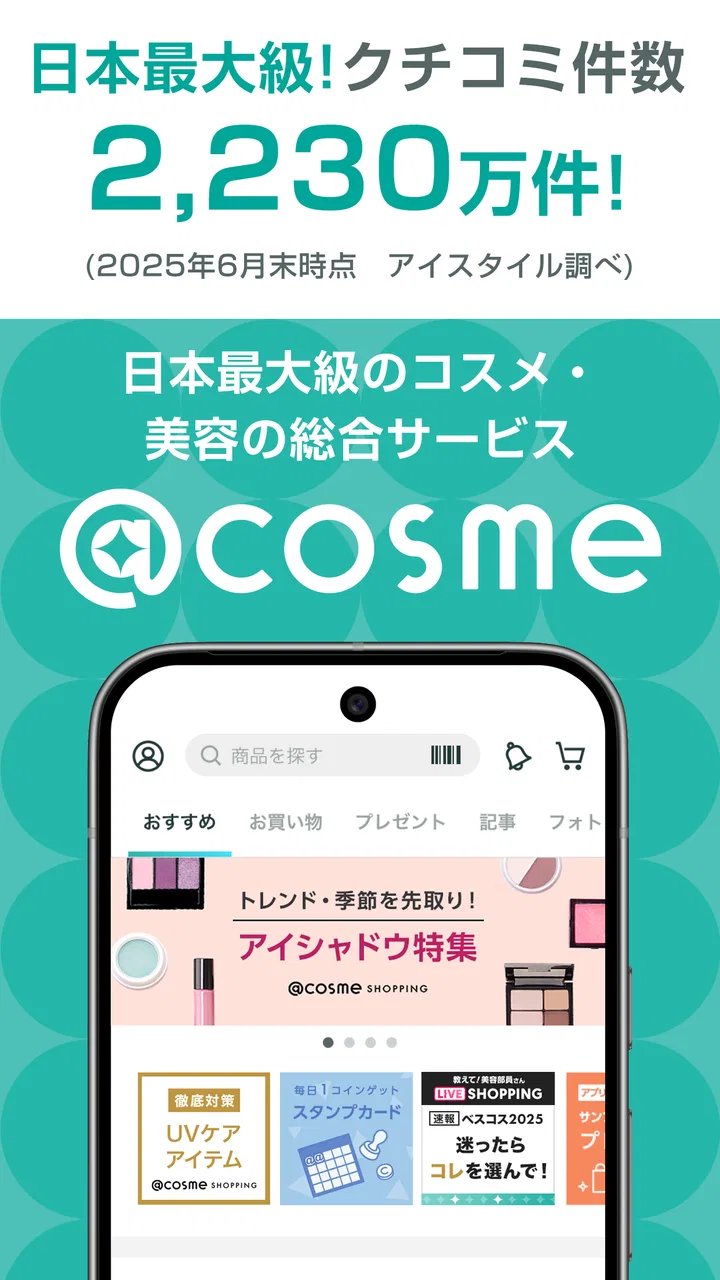
@cosme公式|コスメ・メイクのクチコミ美容アプリ
- 5.0
- Rating
- 1.00M
- Installs
- Free
- Price

 Analysis by App-foxy
I approached @cosme公式 as more than a shopping app. It is a beauty reference tool built around product opinions, rankings, makeup discovery, and the practical question many of us ask before buying: “Will this actually suit me?” Developed by 株式会社アイスタイル, it sits in the beauty category and is available free of charge for everyone. In my experience, its strongest idea is not simply showing products, but giving you several ways to narrow a huge cosmetics market into choices that feel more manageable.
The app is especially useful when I want to compare several foundations, lip products, skincare items, or Korean makeup options without jumping between unrelated pages. Reviews and daily ranking changes give the browsing process more context than a basic retailer catalogue. At the same time, this is not a perfect tool for every shopper. The amount of information can feel demanding, and user opinions still need to be read critically rather than treated as personal recommendations guaranteed to work for everyone.
How comfortably the app supports different ways of browsing
I find the app easier to approach when I treat browsing as a choice between two modes: looking for a particular kind of product or exploring what is currently attracting attention. Starting with a clear question can make a review-heavy visit feel more manageable, while open-ended browsing is better for discovering unfamiliar makeup. In the next section, I’ll look at how those different paths shape the experience.
You May Also Like

 Pandora - Music & Podcasts
Pandora’s Music Is Easy to Start, but Harder to Recover
Pandora’s strength is its low-effort path from a seed to a station. Its weak spot is how much confidence it asks you to place in connection, setup, and quiet recovery.

 AccuWeather: Weather Radar
AccuWeather Review: A Quick, Clear Forecast for Everyday Decisions
For everyday plans, the best forecast is the one you can understand quickly. AccuWeather makes rain timing, radar, and local conditions easy to act on, with a few trade-offs.

 Hill Climb Racing
Why Hill Climb Racing Still Turns Crashes Into One More Run
A tiny car, a bumpy hill and one more upgrade: Hill Climb Racing keeps resurfacing because its simple chaos makes every near-miss feel personal.

 AliExpress - Shopping App
AliExpress Makes Global Shopping Feel Personal, but Shoppers Bear the Risk
AliExpress turns a global marketplace into a pocket-sized discovery engine. Its reach is useful, its shopping loop compelling, and its trade-offs easy to miss.

 Lords Mobile: Kingdom Wars
Lords Mobile Is a Kingdom-Building Routine, Not a Quick Match
A case-by-case verdict on the building, battles, device demands, and social commitments that make Lords Mobile rewarding for some players and exhausting for others.

 PDF Scanner app - TapScanner
TapScanner Makes Paperwork Easier to Capture, Check, and Share
TapScanner makes scanning with a phone feel less like a rescue operation and more like a dependable step in getting work done. Its capture tools are useful, though not flawless.
More From Our News Desk
View All News


Readability and navigation for product research
The clearest way to use the app is to begin with a specific need instead of opening it with no plan. If I am looking for a new mascara, for example, I can use the product-focused areas to compare familiar names, inspect review patterns, and see what is attracting attention in the current rankings. That is more useful than scrolling through a general beauty feed because it gives my visit a purpose.
The app’s store summary highlights cosmetics, makeup products, Korean makeup, reviews, rankings, and purchasing. In practical use, those elements create three different browsing moods. I can research carefully before a purchase, browse rankings for inspiration, or move from discovery toward buying. I like that flexibility, although it also means the experience can feel busier than a minimalist shopping app designed around one item at a time.
For readability, I would treat each product page as something to scan in stages. First I look at the product name and category, then the overall review impression, and only after that do I read individual comments. This prevents a single dramatic opinion from dominating my decision. A long review can be valuable, but it may describe someone else’s skin, climate, routine, or color preference. The useful question is not whether the reviewer loved or disliked an item, but whether their situation resembles mine.
The current release is version 5.130.0, so the app is an established product rather than a newly launched experiment. It first appeared on October 16, 2014, and its scale is visible in the community around it: the listing shows a 5.0 average from around five thousand ratings and more than a million installs. Those figures suggest that the app has attracted substantial interest, but I would still judge individual reviews on their detail and relevance rather than relying on the headline score.
One of my favorite workflows is to use rankings as a discovery shelf, not as a final buying guide. A ranking can reveal products I would not have searched for by name, especially in Korean makeup where unfamiliar brands and formats can otherwise be easy to miss. Once something catches my eye, I compare its review language with my own priorities: shade flexibility, finish, wear, scent, ease of application, or whether it fits a quick morning routine.
This approach also makes the app more manageable for readers who find dense screens tiring. Rather than attempting to absorb every label and review at once, I would choose one product family, inspect a small group, and leave the rest for later. The app is most readable when used as a sequence of short decisions, not as an endless beauty catalogue.
Motor and sensory considerations during everyday use
Cosmetics apps are often judged only by how attractive they look, but comfortable interaction matters just as much. Product research can involve repeated scrolling, opening several pages, comparing names, and moving between discovery and purchase areas. For someone with limited dexterity, hand tremors, fatigue, or difficulty with precise tapping, that repeated movement may become more noticeable than it is for a casual user.
I would not describe the app as a specialist accessibility tool, and I would avoid assuming that every part of its interface works equally well for every person. Its usefulness depends partly on how comfortably a reader can navigate image-led product pages and review-heavy screens. If small controls, dense text, or frequent page changes are difficult for you, the app may require more effort than a simple retailer site or a desktop browser.
There is, however, a practical advantage in the way the content can be approached selectively. You do not need to read every review or inspect every ranking. A person who tires easily can focus on one category, identify a few candidates, and stop once the evidence is sufficient. I find this “shortlist first, deep-read second” method less tiring than opening products randomly.
For sensory-sensitive users, cosmetics research has another layer: fragrance, texture, finish, and visual presentation can all influence whether a product feels suitable. Reviews may help uncover those details when shoppers mention them, but they are not guaranteed to appear consistently. I would use the app to locate clues, then verify important personal concerns through the product information or the retailer before ordering.
People with color-vision differences should also be cautious when judging makeup from promotional images alone. A displayed shade can look different depending on the screen, lighting, and surrounding colors. The app is helpful for finding comparisons and user experiences, but I would not make a shade decision based only on a thumbnail or swatch image. Reading descriptions and checking several user photographs, where available in the app’s content, is a safer workflow.
Situational access: when the app earns a place in my routine
The most realistic use case for me is a rushed shopping decision. Imagine standing in a store before work, holding a product you have never tried. Instead of searching the whole internet, you can use the app to check how people describe the finish, compare it with nearby alternatives, and decide whether it deserves attention. The store-purchase connection is important here because the app is not limited to planning an online order; it can also support a decision while browsing in person.
Another useful situation is preparing for a seasonal change. When my skin or makeup preferences shift, I can look through current rankings and reviews to build a short list rather than assuming the product that worked last season will still be ideal. The daily nature of the rankings makes the app feel more current than a static article, although “popular now” should never be confused with “best for me.”
It can also help someone who is new to cosmetics. A beginner may not know which brands or product types to search for, and rankings provide a starting point. I would recommend choosing one familiar concern, such as a natural lip color or an easy base product, then reading reviews that explain application rather than only praising the packaging. This turns the app into a learning aid instead of a stream of tempting purchases.
For someone shopping with a friend or family member, the app can make comparison more concrete. Rather than arguing from memory about which product was recommended, you can open several entries and discuss the differences in finish, use, and price at the point of decision. The benefit is not that the app makes the choice automatically; it gives the conversation a shared reference.
The app is less suitable when I already know the exact product and only need the fastest checkout. A retailer’s own app may be more direct for stock, delivery, account details, or order tracking. I would choose @cosme公式 when discovery and community feedback matter, and a dedicated shop when speed and transaction management matter more.
Using reviews without letting them make the decision for you
Reviews are the heart of the experience, but they are also where a careful reader needs good habits. I look for comments that explain how a product behaved: whether it settled into lines, felt heavy, lasted through a long day, blended easily, or matched a particular skin type. Short reactions can be useful for spotting a general mood, but detailed experiences are better for predicting whether an item fits my routine.
I also separate performance from preference. A dewy foundation may be praised by one person and criticized by another because their desired finish differs. A strongly scented product may be enjoyable for one reviewer and unpleasant for someone sensitive to fragrance. When several reviews disagree, that does not automatically mean the community is unreliable; it may mean the product behaves differently across people and conditions.
A particularly useful tactic is to search for repeated practical language rather than repeated enthusiasm. If several reviewers independently mention difficult blending, quick drying, or a narrow shade range, I pay attention. If many comments simply say that a product is “amazing,” I treat that as encouragement to investigate, not proof that it belongs in my basket.
The same rule applies to Korean makeup discovery. The app can expose me to products that are not already part of my routine, but unfamiliarity increases the need for careful reading. I would check the product type, intended finish, application method, and any personal concerns before assuming that a popular item will translate directly to my own habits.
Remaining barriers and points of friction
The first barrier is information density. Beauty shoppers often want detail, but detail can become tiring when product images, rankings, review text, and shopping paths compete for attention. Someone who prefers a calm, linear experience may find the app less comfortable than a simple search engine result or a retailer page with fewer choices.
The second barrier is the gap between community language and personal certainty. Reviews can describe real experiences, but they cannot guarantee a match for your skin, shade, allergies, climate, or application technique. I would never use a positive review as a substitute for checking ingredients or following professional advice about a skin concern. The app supports research; it does not replace personal testing or medical guidance.
A third issue is decision fatigue. Rankings are excellent for finding ideas, yet a constantly changing list can encourage endless comparison. My solution is to set a stopping rule before I begin: shortlist a few products, identify the strongest reason for and against each, and then decide whether I need more information. Without that limit, the app can turn a simple purchase into an evening of scrolling.
There is also a trade-off between discovery and privacy of attention. Moving from reviews to purchase options is convenient, but it can make browsing feel more commercial than a purely editorial beauty community. I appreciate the ability to buy through the app or in stores, but I prefer to separate “interesting” from “necessary” so that convenience does not rush the decision.
Readers who need highly predictable navigation, large text, strong contrast, keyboard-oriented use, or specific assistive technology support should test the app personally before making it their main beauty reference. I cannot treat its general availability rating as proof of accessibility for every ability. If the interface creates strain, a browser, a retailer with a simpler layout, or help from another person may be the better option.
Who will benefit most from this beauty community
I would recommend the app to people who enjoy comparing cosmetics and want more than a product photograph. It is a strong fit for curious shoppers, makeup beginners, trend followers, and anyone exploring Korean makeup without knowing where to start. It is also useful for people who like reading real-world experiences before spending money, especially when several products appear similar at first glance.
It suits a flexible research style. You can browse rankings for inspiration, investigate a specific product, read opinions, and continue toward a purchase when ready. That combination is more useful than a basic catalogue for someone who is still deciding what to buy.
I would be more cautious about recommending it to a shopper who dislikes reviews, wants a single authoritative answer, or needs a very fast transaction. It is also not my first choice for someone who needs highly structured accessibility controls or who finds image-heavy, frequently updated content overwhelming. In those cases, a simpler retailer or a personal consultation may provide a clearer path.
The free price makes trying it low-risk, and the Everyone age rating means it is presented for a broad audience. Still, free access does not remove the need for sensible shopping habits. I would use it to compare and learn, then make the final decision based on my own needs, the product details, and whether the purchase fits my budget.
My inclusive verdict after using it as a research companion
The best way to think about this app is as a guided beauty research space, not an automatic answer machine. Its combination of review culture, current rankings, product comparison, Korean makeup discovery, and purchase options gives it a clear identity. I especially value the ability to move from “I wonder what is popular” to “which of these choices actually fits my routine?” without starting the search again elsewhere.
Its support for different abilities and situations is mixed in a realistic way. The content can be approached in small portions, which helps people who need shorter sessions or who prefer gradual decisions. Store browsing and product research can also make the app useful outside the home. But dense information, repeated scrolling, image dependence, and the variable quality of user comments may create friction for people with visual, motor, cognitive, or sensory needs.
My practical recommendation is to use a focused workflow: choose one category, shortlist a few products, read detailed comments from people with similar needs, and verify important personal concerns before buying. That method brings out the app’s strengths while reducing its tendency to overwhelm. If you want discovery and community insight, it is worth installing; if you only want the quickest checkout or the simplest possible interface, another shopping option may serve you better.
Overall, I see @cosme公式 as a useful companion for thoughtful cosmetics shopping. It does not make personal judgment unnecessary, and it cannot make every beauty experience equally accessible, but it gives me a richer starting point than a conventional product list. For readers willing to browse selectively and question what they read, this free beauty app offers genuine help in turning a crowded cosmetics market into a more understandable set of choices.
FAQs for @cosme公式|コスメ・メイクのクチコミ美容アプリ
01What features does the @cosme公式 app offer to users?
The @cosme公式 app provides a comprehensive platform for beauty enthusiasts to explore product reviews, makeup tutorials, and skincare tips. Users can access thousands of authentic reviews from the community and share their own experiences. The app also includes a ranking feature for trending products and a personalized recommendation system based on user preferences.
02Is the @cosme公式 app available in multiple languages?
As of the latest update, the @cosme公式 app primarily supports the Japanese language, as it caters mainly to users in Japan. However, given its popularity, there may be plans for future updates to include additional languages. Users should check the app store for the most recent language options.
03Are the product reviews on the @cosme公式 app reliable?
Yes, the reviews on the @cosme公式 app are considered reliable because they are submitted by real users who have tried the products. The platform encourages honest feedback and provides a rating system that helps users gauge the effectiveness and quality of products before making a purchase.
04Does the @cosme公式 app offer any purchasing options within the app?
While the @cosme公式 app is primarily focused on reviews and community interaction, it often includes links to online stores where users can purchase products. This feature allows users to seamlessly transition from discovery to purchase, though the app itself does not handle transactions directly.
05Is the @cosme公式 app free to use, or are there any subscription fees?
The @cosme公式 app is free to download and use, offering a wide range of features at no cost. Users can access reviews, product rankings, and beauty tips without any subscription fees. However, there may be optional in-app purchases or advertisements that help support the platform.
Pros
- User-friendly interface for easy navigation.
- Extensive database of beauty products.
- Real user reviews and ratings available.
- Personalized recommendations based on preferences.
- Regular updates with the latest trends.
Cons
- Only available in Japanese language.
- Limited international product availability.
- Requires account creation for full features.
- Some ads may disrupt user experience.
- No offline mode for browsing reviews.

@cosme公式|コスメ・メイクのクチコミ美容アプリ
Gallery